
AI Agents for Business: The Complete Guide to Automating Customer Relations in 2026
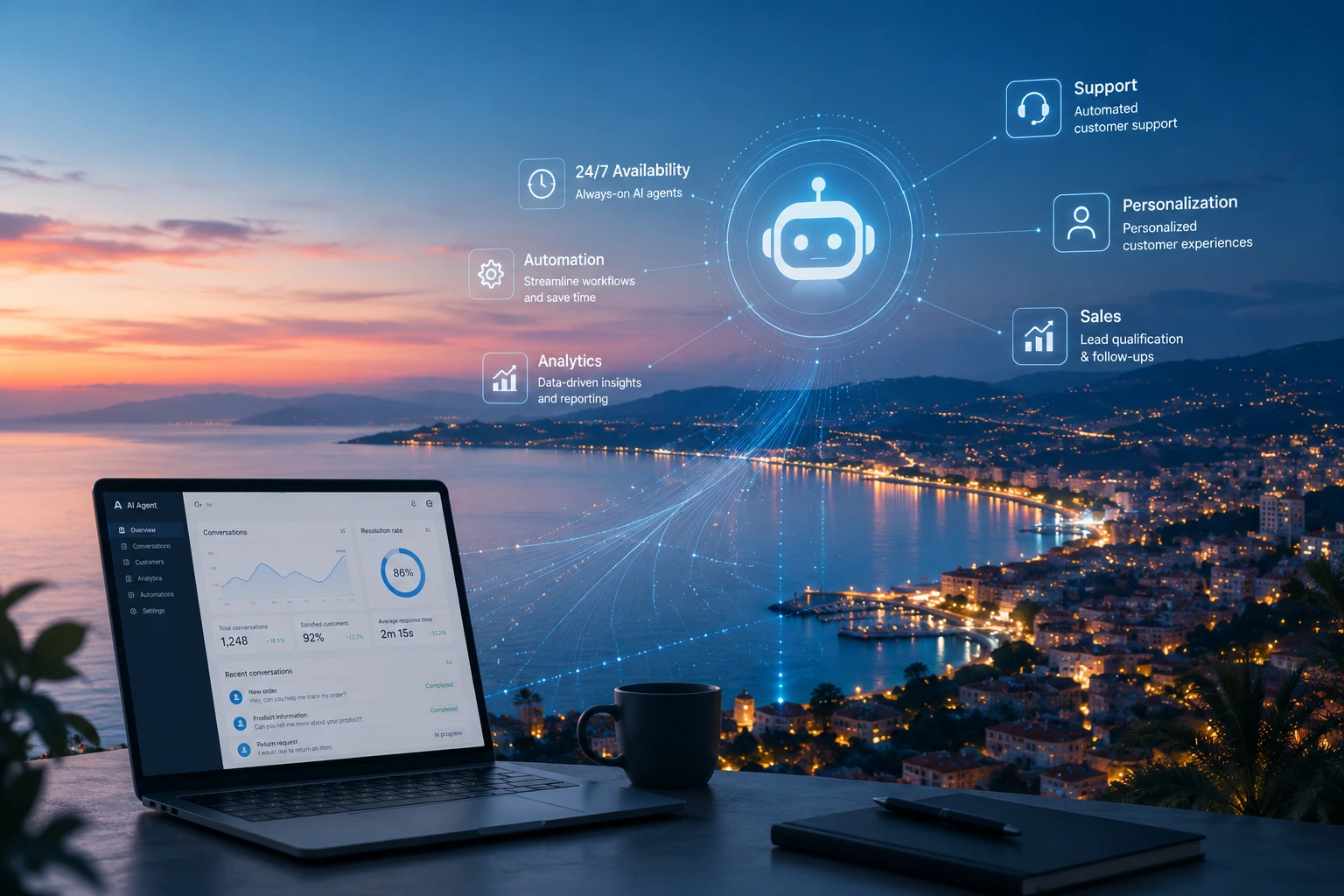
2025 and 2026 marked a turning point in how artificial intelligence concretely integrates into everyday tools — not just to generate text, but to act: answering a customer, checking a calendar, qualifying a request. For a French Riviera business fielding questions around the clock, this shift has very concrete value, as long as you clearly separate genuine gains from marketing talk.
What exactly is an AI agent?
An AI agent differs from a classic chatbot in its ability to understand a freely worded question, rather than following a fixed decision tree with predefined buttons. It looks up the relevant answer in your business’s actual content — your services, hours, catalogue — and can chain several actions (answering, asking a follow-up question, offering a time slot) without human intervention, while recognising the limits of its scope.
Concrete use cases for a local business
Answering outside opening hours
A visitor asking a question on a Sunday evening won’t wait until Monday morning. An AI agent instantly answers the most frequent questions — indicative pricing, service area, turnaround times — without pulling anyone off your team.
Qualifying a request before the first human contact
Rather than collecting just a name and an email address, the agent can ask the essential questions (project type, indicative budget, timeline) before handing you an already-qualified contact — a direct time saving on every sales enquiry.
Automating appointment booking
Connected to your real calendar, the agent offers available slots and confirms the appointment without the usual email back-and-forth.
Supporting an online purchase
For an ecommerce shop, an agent able to answer questions about product availability, delivery times or item specifics right inside the checkout flow reduces abandonment caused by an unanswered question.
Never leaving a review unanswered
The agent can detect new Google reviews and suggest a reply matched to the tone and content of the review, for more systematic reputation management.
What an AI agent doesn’t replace — and shouldn’t
The temptation to automate everything exists, but it’s counterproductive. A commercial negotiation, a sensitive complaint, or an unusual situation outside the expected scope should stay with a person. The value of a well-designed AI agent isn’t measured by how many tasks it automates, but by its ability to hand off cleanly to a human as soon as the situation calls for it — rather than creating a frustrating dead end.
How to integrate it without technical complexity on your end
The technical integration — connecting to the site, the calendar, the catalogue — is handled by the agency deploying the agent. What’s left on your end is mainly precisely defining the use cases genuinely useful for your business, and providing up-to-date content the agent can rely on to answer correctly.
Customer data security and privacy
A point too often glossed over in AI marketing talk: where are conversations hosted, and for what purposes are they used? GDPR-compliant infrastructure, with no reselling of data to third parties, is a non-negotiable prerequisite — to be explicitly verified before any deployment, whatever the provider.
Our approach at Webest Riviera
We scope every AI agent project around precise, measurable use cases, rather than installing a generic off-the-shelf solution. You can explore our AI Agents & Automation service in detail, or get in touch to assess what would have a real impact on your business.
In short
AI agents are no longer science fiction, nor just a marketing talking point: properly scoped, they efficiently handle recurring requests, qualify contacts, and free up time for what genuinely needs a human touch. The key is choosing concrete, measurable use cases, rather than giving in to the temptation of automating everything at once.
Frequently asked questions
What's the difference between a chatbot and an AI agent?
A classic chatbot follows a rigid script with predefined answers. An AI agent understands a freely worded question, looks up the relevant information in your actual content, and adapts its answer to the context of the conversation — with the ability to recognise its own limits rather than inventing an incorrect answer.
Can an AI agent replace my customer service?
No, and that's not its purpose. An AI agent efficiently handles recurring requests and qualifies contacts, but a negotiation, a sensitive complaint, or an unusual case should stay in a person's hands.
Is it complicated to set up for a small business?
The technical complexity is handled by the agency integrating it. On the business side, the main work is clearly defining the useful use cases and providing up-to-date content the agent can rely on.
Is customer data exchanged with the agent protected?
Yes, provided the chosen infrastructure is GDPR-compliant and the data is neither resold nor used for purposes other than serving the customer — a point to explicitly verify with your provider before any deployment.
How much does integrating an AI agent into an existing site cost?
The cost depends directly on the number of use cases to cover and the level of integration with your existing tools (calendar, CRM, catalogue). A simple use case (answering frequent questions) costs noticeably less than a full integration with booking and lead qualification.
Ready to take your online presence further?