
WordPress, Webflow or a custom-built site: which should you choose in 2027?
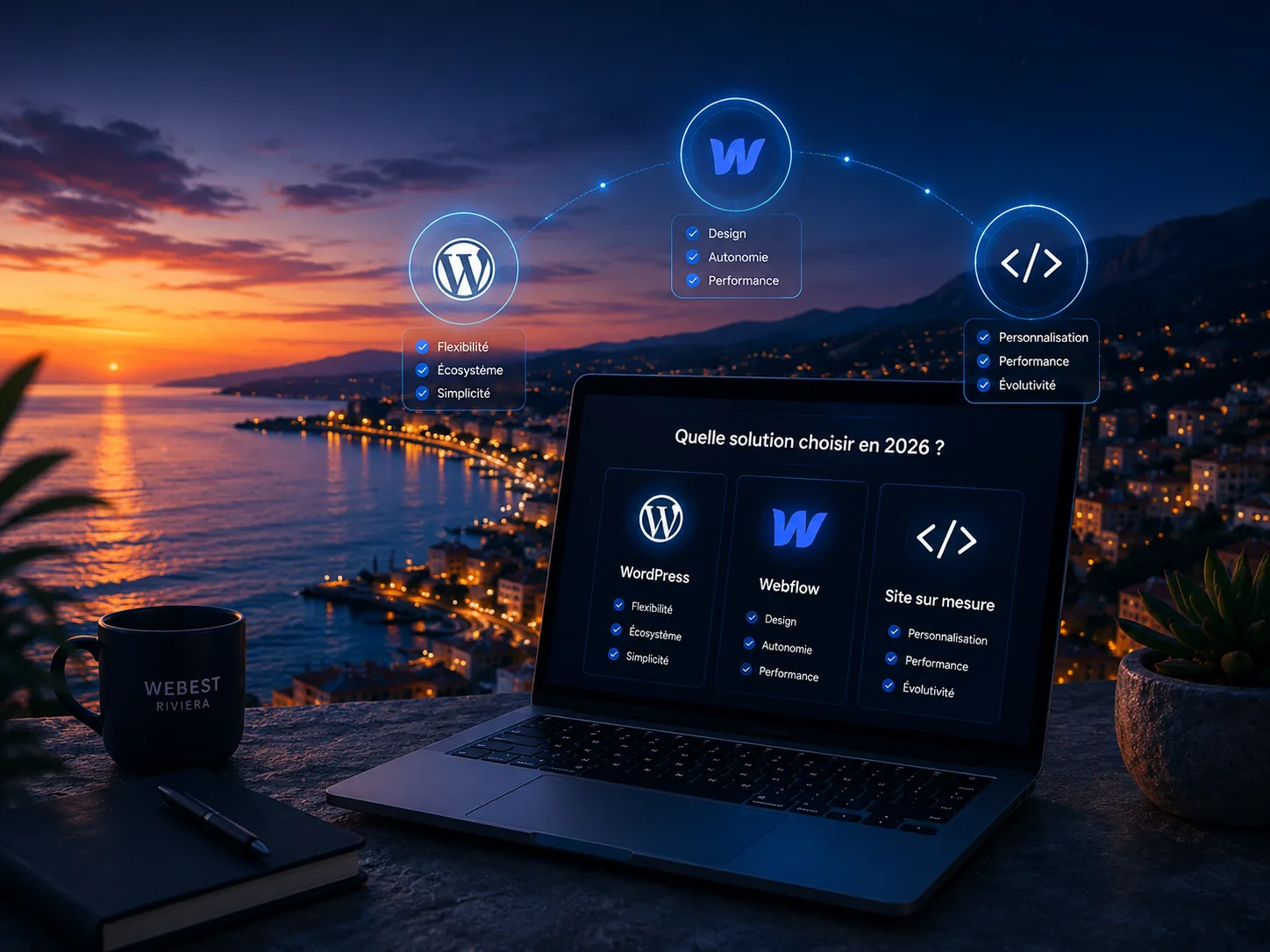
Choosing the technology behind your website is a bit like choosing a house’s foundations: you no longer see them once the work is done, but they decide everything that follows — speed, security, what you can edit yourself and what the site costs you every year. Three broad families cover most projects today: WordPress, visual platforms such as Webflow, and the custom-built site. None is best in absolute terms; each fits a specific situation.
WordPress: versatility, at the cost of regular upkeep
WordPress runs more than 40% of websites worldwide. Its strength is its ecosystem: thousands of themes and plugins let you add almost any feature — bookings, advanced forms, an online shop, a members’ area — without custom development. Many editors already know its admin interface, and it’s easy to find someone to take over an existing site.
That flexibility comes at a price. Every plugin adds weight to the page and becomes a dependency to keep up to date: the WordPress core, the theme and each plugin regularly publish fixes, many of them security-related. A WordPress site left without updates for a few months becomes an easy target. Performance also needs attention — caching, image optimisation, suitable hosting — to stay fast on mobile.
Who is it for? Sites that change very often, sites that need a specific, proven plugin, and teams already used to the tool — provided a maintenance plan is in place from day one.
Webflow: visual design, in a closed environment
Webflow is an online platform for designing a site visually, with a lot of creative freedom, while producing clean code. Hosting, security and updates are handled by the platform: there are no plugins to watch over. For polished showcase sites, landing pages or marketing teams who want to control the layout themselves, it’s an effective tool.
Its limits come from its model. Webflow works on a subscription whose price rises with the number of content items, traffic and the features you use. Above all, the site stays tied to the platform: you can export the pages’ code, but not how the CMS or e-commerce works. The day you want to switch tools, a site built on content collections has to be rebuilt. Finally, some advanced features require third-party integrations, which are paid too.
Who is it for? Visually demanding showcase sites, run by a team that wants to edit its own pages and is happy to stay on the platform.
The custom-built site: performance and independence
A custom-built site is developed specifically for your business, with no generic theme and no stack of plugins. Modern technologies can now generate static sites: every page is prepared in advance and served instantly, with no database to query on each visit. The result is a very fast site with a minimal attack surface and low hosting costs.
It’s the approach we use for most of our projects, such as Les fours à pizza, a buying guide built with Astro, or our own site. The client can still edit the content through a simple interface, without touching code, and the site belongs to you entirely: no platform can change its prices or terms under your feet.
The trade-off: building it takes more work up front, and a very specific feature has to be developed rather than installed in one click. You need a provider who masters these technologies and stays available to evolve the site.
Who is it for? Businesses that want a fast, well-ranked and lasting site, without depending on a platform or plugins to monitor.
Compare over time, not just on the quote
The build price is only part of the equation. To compare honestly, add up three to five years of:
- WordPress: build, hosting, any premium plugins, and regular maintenance (updates, backups, security monitoring).
- Webflow: build, a monthly or yearly subscription that grows with the site, any third-party integrations.
- Custom-built: build, lightweight hosting, and occasional work on new features — with very little security maintenance.
Questions to ask before choosing
- Who will update the site, and how often? A team publishing daily doesn’t have the same needs as a business that edits its pages twice a year.
- Does the site need a very specific feature? If a proven plugin already exists, WordPress can save time.
- How much do speed and search rankings matter to you? On mobile, every second of loading counts, for your visitors as for Google.
- Do you want to be free to change provider or tool? A custom site or a well-built WordPress site can be taken over; a Webflow site, far less so.
- What yearly budget are you prepared to spend on the site? Subscription, maintenance, new features: that’s the figure that makes the difference over time.
Our recommendation
There’s no bad technology, only ill-suited choices. For a showcase or content site that needs to be fast, secure and well positioned on Google, we recommend custom-built. For a site that depends on a specific WordPress plugin, or whose team already knows the tool, WordPress remains relevant — with serious maintenance. What matters most is asking the question before signing, and asking it of your provider.
Weighing up several options for your project? Our website design page explains our approach, and we’re happy to talk it through in a first conversation, with no commitment.
Frequently asked questions
Is WordPress still a good choice in 2027?
Yes, for a site that a non-technical team updates often, or that needs a specific plugin that already exists. It does require regular maintenance, though: updates to the core, theme and plugins, which are also the main source of security holes.
Can you easily move away from Webflow?
Partly. Webflow lets you export the HTML and CSS of your pages, but not how its CMS or e-commerce works: a site built on content collections has to be rebuilt elsewhere to leave the platform.
Is a custom-built site necessarily more expensive?
Not necessarily over time. Building it takes more work up front, but a well-built static site has no platform subscription, no paid plugins and very little security maintenance. Over three to five years, the gap often narrows or even reverses.
Will I be able to edit my custom site myself?
Yes, as long as the agency plans for it: a simple editing interface lets you change text, images and articles without touching code. That's what we deliver with every site we build.
Ready to take your online presence further?